Electric Sheep: the website with a digital flock
10 Nov 2026 · By the Boring Websites editors
Electric Sheep is a collaborative artwork that turns abstract animations into an evolving population, with computers sharing rendering work and viewers expressing preferences. The unusual attraction is the relationship between the pictures: even a screensaver can have ancestors.
In brief
- Scott Draves' artist account dates Electric Sheep to 1999.
- The official introduction describes a flock shaped by rendering, voting, mutation and crossover.
- The artist's Clade page and family-tree illustration make the visual relationships concrete.
- The homepage is an entry point to a larger software artwork, rather than a self-contained browser toy.
The website is the front gate, not the whole field
The Electric Sheep homepage presents two layers of the project. At the top, a next-generation notice points to Infinidream. Below that sits an introduction to the collaborative artwork, followed by desktop and app download sections. These are the published routes visible during research, rather than a report that every linked installer has been exercised.
That distinction helps explain what kind of website this is. A visitor looking for a button that immediately produces an entire artwork may find a project introduction instead. The site explains an arrangement involving machines, software and an audience. Its subject extends beyond the page, just as a museum's description of an installation extends beyond a photograph of it.
The most economical reading route begins with the introduction, then follows the link to Scott Draves' account of Electric Sheep. The artist identifies 1999 as the beginning and describes computers rendering portions of animations, a server assembling them, and the results returning to viewers. The page also places a family diagram and a grid of images alongside the explanation.
For a casual visitor, those illustrations are more useful than a long list of platform names. They show why a collection of animations is being described as a population. Each frame can be considered separately, but the arrangement asks for another kind of attention: a search for similarities, variations and relationships among the pictures.
A conventional screensaver offers a decorative interval while the machine awaits its next instruction. Electric Sheep makes that interval the occasion for a larger process. The pleasing absurdity is the mismatch in scale. Something intended to occupy the background arrives with a history, a mechanism and an extensive set of relatives.
The resulting visit can remain small. Understanding the concept does not require installing a client or contributing a rendered frame. Someone can arrive at the website, inspect the artist's examples and leave with a sharper idea of what collaborative software art might mean. The doorway is worth examining even before a decision about entering the building.
A close look at the pictures and their relatives
One of the images linked from the artist's Clade page is the sample identified in its filename as Electric Sheep 243.14615. In the retrieved still, a narrow blue arc crosses a dark field. A bright oval, edged in yellow and blue, rises from the lower left, while thin orange lines cut diagonally through the frame.

The visual effect is less like a picture of an object than a fragment of an unfamiliar instrument. The oval suggests a rim; fine parallel marks suggest a surface stretched across it. Those are editorial impressions of the still, not a claim about what the work literally depicts. The image supplies enough structure to invite associations without confirming any of them.
The dark areas matter as much as the bright marks. The glowing oval occupies only part of the frame, leaving room for separate arcs and crossings. That spacing makes the composition feel larger than its little rectangle. It resembles a detail taken from a process continuing somewhere beyond the edge, rather than a neatly centred emblem.
The family-tree illustration on Draves' project page offers a different visual experience. Small rectangular images are connected by lines across a white background. Warm orange patterns sit near cooler blue ones; circular centres recur in the lower branches. The diagram makes ancestry inspectable as an arrangement, rather than leaving it as a metaphor in the prose.
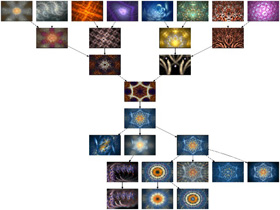
A row of pictures invites comparison, but connected pictures invite explanation. The lines encourage a visitor to look for what might have carried across a relationship: a central glow, a repeated ring, a change from dense texture to open space. Visual resemblance alone does not prove a particular inheritance; the diagram supplies the relationship while the viewer notices possible likenesses.
On the Clade page, Draves describes the Trefoil series as a selection involving six sheep across ten generations. That gives the family idea a manageable scale. A visitor can consider a small group instead of trying to absorb an entire evolving population. The artwork becomes something between a visual study and an extremely luminous family album.
These examples also explain why a single still cannot stand in for the whole project. It can show colour, balance and texture. The diagram adds relationships, and the system's description adds change over time. Those are distinct kinds of information. A pleasing thumbnail is an invitation to investigate the other two, rather than evidence that they are unnecessary.
The recipe is separate from the rendered picture
The Flame project's introduction explains that its images and animations are generated algorithmically, with a numerical description specifying shape and colour. It dates the original software to 1992 and links Electric Sheep as a route into collective evolution and animation. This is the practical foundation beneath the more picturesque language about flocks.
The important distinction is between instructions and an image produced from them. A recipe is not the cake, and a numerical description is not the luminous shape on the screen. The description can be stored or changed separately from a finished rendering. That makes the idea of an inherited recipe easier to follow than a story about pictures somehow mating.
Draves' 2007 technical chapter describes separate client tasks for downloading animations, playing them from a cache and rendering assigned frames. The server gathers frames into animations. This is a historical architecture description, not a claim about a freshly benchmarked release. It clarifies why watching a finished sequence and calculating a new frame are different jobs.
That separation removes a common source of confusion in the phrase computer-generated art. A computer can display a result produced elsewhere, contribute to producing another result, or do both at different moments. The visible picture alone cannot reveal which task is happening. The artwork's organisation is therefore part of its subject, even when the immediate experience looks like a moving image.
A useful way to read the mechanism is to keep three objects distinct: the recipe, the individual rendered frames and the assembled animation. Confusing them makes the project sound more mysterious than it needs to be. Keeping them separate preserves the actual oddness: many machines can participate in making something whose viewer sees only the finished surface.
The same technical chapter describes rendering transitions between sheep, as well as the individual animations. That is an especially revealing detail. A population of separate works still needs a way to become a viewing sequence. In the documented system, the passage from one member to another is itself material to be computed.
For a viewer, this suggests two different pleasures: the identity of a particular form and the movement between forms. A still image answers the first question only partially. A family diagram answers another question altogether. The project rewards looking at its documentation because each representation exposes a different part of the arrangement.
Voting makes the audience part of the process
The official Electric Sheep introduction says viewers can vote using the keyboard and that popular animations persist and reproduce through a genetic algorithm involving mutation and crossover. This is the central participatory idea. Preference helps shape the flock instead of remaining a private reaction after the image has appeared.
The biological vocabulary is useful when it stays attached to that mechanism. A sheep is an animation, not an animal with sensations or needs. Its recipe provides something that can vary, and the selection process gives some variations a greater role. The farmyard terminology is memorable precisely because the underlying objects are so unlike livestock.
The summary of Draves' 2007 chapter includes another important route into the population: people can design sheep for the gene pool. The chapter's stated conclusion frames the algorithm as an amplifier of human collaborators' creativity. That is a more interesting account than a simple contest between a lone artist and an autonomous machine.
In editorial terms, there are several kinds of participation here. Someone devises the framework; someone contributes a design; someone supplies computing work; someone expresses a preference. Those roles need not collapse into one definition of authorship for the collaboration to be intelligible. The arrangement allows contributions at different levels.
A vote also deserves a narrower interpretation than a verdict on beauty. Within such a system, it indicates a participant's preference under particular conditions. It does not establish a universal ranking of worthwhile images. That distinction leaves room for disagreement, which is useful in an artwork whose central premise includes many people looking at different things.
Popularity and curiosity can point in different directions. An editorially interesting image might be awkward, sparse or unlike its neighbours, even if a more immediately attractive image would win a casual preference. The evolutionary premise gives a visitor a reason to consider that tension rather than reducing the collection to a wall of favourites.
The family-tree image gives this question a concrete anchor. A viewer can look at a connected group and consider which member seems most appealing, then notice whether the answer depends on the surrounding relatives. An image can acquire interest from its position in a sequence. The artwork and its explanation do not have to compete for attention.
Collaboration has names, and reuse has conditions
The Electric Sheep credits page makes the collaboration less abstract. It credits Draves as founder, lists programmers, attributes sheep design to the flock and gene pool, and identifies the Internet Archive as providing hosting for the free version. Those are the project's published credits, rather than an independent measurement of each contributor's role.
A credit list changes the reading of collective art. The word collective can sound as if individual work has dissolved into an anonymous crowd. A list of names restores the practical labour behind the premise. Someone writes software, someone makes designs, and someone supplies infrastructure. The result can be shared without its production becoming authorless.
The official reuse policy distinguishes the licensing of automatically generated sheep from human-submitted designs and directs visitors to the licence attached to each archive entry. Its instructions also emphasise attribution and source identification. Anyone planning reuse should follow the relevant item and its terms rather than treating every image linked by the project as interchangeable.
For this field guide, linking the artist's samples provides a straightforward route to the originals. It also preserves useful context: the page that identifies a work, the surrounding explanation and the relationships that a detached image might lose. A copied luminous rectangle would convey colour, but not necessarily its place in the project.
The lesson for a visitor is quite practical. Viewing, contributing software and republishing an image are separate activities. Finding an open project does not remove the need to identify the terms governing a particular work. The project's own distinctions are more useful than a general impression that everything on an unusual art website must be available on the same basis.
A first visit that does not become an installation project
The quickest route through the material is a sequence of three stops: the official introduction, the artist's project account, and the Clade selection. Together they provide the premise, a description of its organisation, and a smaller visual grouping. A software installation is a separate decision.
For that decision, the official FAQ is more informative than the broad download invitation alone. It explains that a newly installed client starts with an empty cache and needs animations to arrive. It also says many users are not rendering much of the time. An apparent absence of rendering is therefore not, by itself, evidence that the documented arrangement has failed.
The same FAQ records a specific Mac limitation: Catalina's screensaver sandbox interfered with downloading, voting and other interactive commands. It describes running the application separately as a route for downloading content. This is the project's published compatibility note, not a newly performed test of a current Mac. It is a good reason to read the details before interpreting a download button as a guarantee.
No screensaver installation, vote or rendering job was tested for this guide. The research inspected the official pages, the artist's linked stills and diagram, and the technical chapter. That scope supports a field guide to the artwork and its documented mechanism; it does not support a promise about a particular computer's installation experience.
For someone interested mainly in the images, the small sample and the family diagram already offer different ways into the subject. The first asks what a form looks like. The second asks how forms relate. The documentation adds a third question: what kind of process can keep producing and selecting such relationships?
A background image with an eventful ancestry
The contextual neighbour in the Boring Websites network is Sandpile. The curatorial connection is the pleasure of watching rules acquire a visible shape. Electric Sheep adds another layer to that interest: the shape belongs to a documented arrangement of contributions, preferences and relatives.
Its most distinctive idea is not simply that mathematics can produce an attractive pattern. It is that the pattern can be treated as one member of a continuing population. The website's explanations, the connected thumbnails and the artist's selection each give that idea a different scale, from a single luminous oval to the broader account of a flock.
The detour fits comfortably within the Boring Websites network: a modest reason to stop at a particular corner of the web, followed by something unexpectedly specific to notice. Electric Sheep offers background imagery with an unusually eventful ancestry. Even the wallpaper appears to have relatives worth visiting.
FAQ
What is Electric Sheep?
The official site presents a collaborative abstract artwork involving animations, shared computation and audience preference. Its website explains a larger software project rather than containing the entire artwork as a browser toy.
Who created Electric Sheep?
Scott Draves' artist account dates its creation to 1999. The separate credits page recognises programming, design and infrastructure contributions.
Where does the name come from?
The 2007 chapter summary identifies Philip K. Dick's novel Do Androids Dream of Electric Sheep as the reference, with the screensaver imagined as a computer's dream.
Is installing the screensaver necessary to understand the project?
The official introduction and artist's illustrated pages explain the premise without installation. Someone seeking participation should read the FAQ and current instructions for the intended platform.